
Event Date Oct 01, 2026
Aquí Estamos: Identity, Migration & Belonging
Arce’s book tells the story of the career she built on Wall Street, one she wasn’t legally allowed to have, because she was undocumented
Arce’s book tells the story of the career she built on Wall Street, one she wasn’t legally allowed to have, because she was undocumented
This webinar will feature Amada Armenta, director of LPPI and co-author of the report; Rudy Espinoza, president and CEO of Inclusive Action; community partners; and small-business owners, each discussing the report’s findings and the impacts of immigration enforcement on small businesses and entrepreneurs from their own vantage point.
Drawing on findings from the UCLA Latino Policy and Politics Institute’s recent report, this webinar will examine why progress in educational attainment does not always translate into equitable economic opportunity. Researchers and panelists will explore the barriers that continue to shape Latino outcomes in higher education and the labor market.
This year’s theme frames LPPI’s research as essential civic infrastructure: evidence that protects community health, strengthens economic stability, and supports institutions in responding effectively during disruption and recovery.

Latinos are a driving force in the U.S. economy. They account for nearly one-fifth of the population, drive workforce growth, anchor essential industries, and contribute more than $4.1 trillion annually to the U.S. GDP, an economy larger than that of most countries in the world.

The UCLA Latino Policy and Politics Institute and the Arizona State University School of Transborder Studies will host a panel discussion on April 8 that confronts a sobering reality: Latinos represent a significant share of the immigration enforcement workforce even as enforcement actions disproportionately target Latino communities.

This full-day workshop gives scholars a hands-on introduction to effective strategies for policy and media engagement.
This webinar spotlights LPPI’s latest research on wildfire recovery and brings community leaders into conversation to assess progress one year after the fire, and chart priorities for an equitable recovery and long-term resilience.

This session will introduce new LDH features designed for researchers, policy advocates, journalists, and legislative staff who need accessible, timely, and localized data to inform their work. Highlights include redesigned filters, customizable charts, and—for the first time—congressional district-level data.
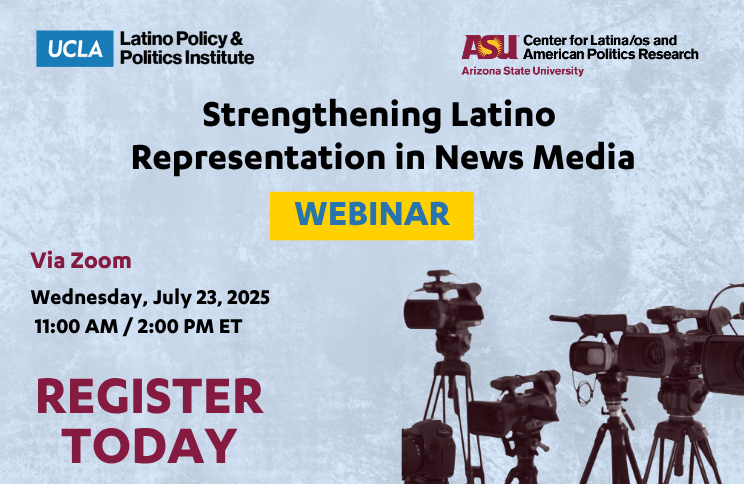
Grounded in findings from the newly released issue brief authored by Francisco Pedraza, associate professor at ASU and the director of CLAPR, which analyzes over 13 million newspaper articles from 2020 to 2023, this conversation will move beyond identifying disparities to explore practical strategies for change—inside and outside the newsroom.
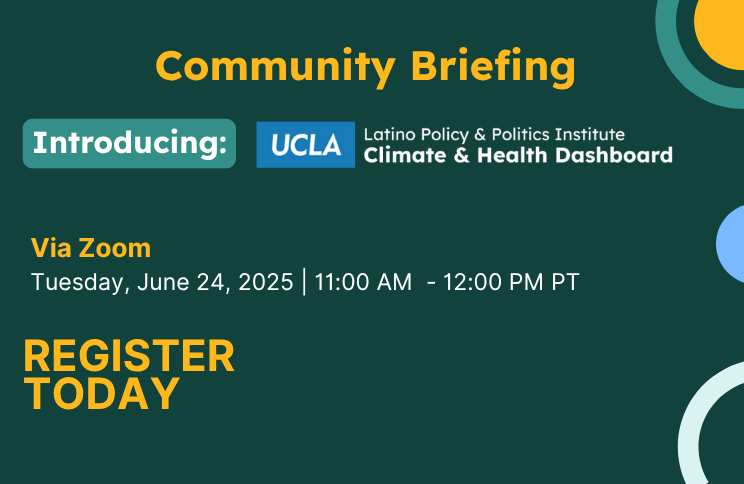
Developed by the UCLA Latino Policy and Politics Institute (LPPI) with guidance from a statewide advisory committee of climate justice, public health, and data equity leaders, this new digital resource is the first of its kind to provide Latino neighborhood-level data on how climate and health inequities are impacting our communities across California.

Join us in expanding opportunity for
all Americans
We care about the protection of your data. Read our Terms of Use.