








Rebuilding for Whom? An Analysis of Tenant Demographics, the Rental Market, Affordability, and the Rebuilding Efforts in Altadena
Executive Summary
This policy brief is the second in our Rebuilding Altadena: Housing Recovery After the Eaton Fire series, which examines equity in post-disaster housing recovery in Altadena, California. While the first brief focused on single-family homeowners, this policy brief centers on tenants and the rental market. Building on prior disaster research, it provides a data-driven picture of how tenants have been affected and how they are faring in Altadena’s recovery. We draw on Census data, rental listings, fire damage assessments, construction permits, and property sales to examine how the rental market functioned before the fire and how it is changing in the aftermath.
Key Findings:
- Before the fire, more than one fifth of Altadena’s households were tenants(renters); most of these tenants were long-term residents, with nearly 70 percent having lived in Altadena since 2010.
- Before the Eaton Fire, tenant heads of household in Altadena were more likely to be of color than homeowner heads of households. Latino heads of household, specifically, were nearly twice as likely to be tenants as homeowners in Altadena before the Eaton Fire.
- Before the Eaton Fire, Altadena’s tenant households included both seniors and families with children facing distinct vulnerabilities to displacement. About 22 percent of Altadena tenant households were headed by seniors (age 65 and older) and about a quarter of tenant householders were living with their own children.
- Prior to the Eaton Fire, tenant households in Altadena had substantially lower incomes than homeowner households and were far more likely to live in poverty. The median household income for tenant households was less than half that of homeowner households, and tenants were more than four times as likely to live below the federal poverty line.
- Altadena’s tenant households were cost-burdened prior to the Eaton Fire. More than half of Altadena’s tenants were cost-burdened in 2023. Latino tenants were among the most financially strained, with more than 60 percent reporting a rent burden.
- Altadena had a sizable rental market that was significantly impacted by the 2025 Eaton Fire. Seven in 10 properties with recorded rental units were located within the Eaton Fire perimeter. Of those, 927 units were on properties where buildings sustained severe structural damage (50% or more of the building destroyed by the fire).
- A substantial share of Altadena’s rental housing was rent-stabilized and located in fire-affected areas. Prior to the Eaton Fire, there were about 792 recorded rent-stabilized units in Altadena. Over two thirds of these units were located within the fire perimeter.
- Rent stabilization in Altadena had strong affordability benefits for family-sized units before the Eaton Fire, creating substantial rent gaps relative to the non-rent-stabilized market. On average, rent-stabilized two-bedroom units rented for approximately $600 less per month than comparable non-rent-stabilized market units, while rent-stabilized three-bedroom units rented for about $700 less.
- The Eaton Fire may have reduced the supply of naturally affordable rental housing. Non-rent-stabilized units located on properties that sustained severe damage (defined as 50 percent or more of the building destroyed) had rents that were, on average, 17 percent lower than comparable non-rent-stabilized units on properties that did not sustain severe damage.
- Rental housing recovery has been slow in the aftermath of the Eaton Fire, with limited sales, listings, or rebuilding activity one year later. One year after the fire, about 74 percent of all rental units within the fire perimeter were on properties with no publicly observable recovery action.
Policy Recommendations:
- Provide interim and temporary housing stability for displaced residents such as funding master leasing at scale and standardizing coordinated disaster case management.
- Improve access to land and capital to enable public and nonprofit entities to acquire fire-impacted properties and redevelop them with long-term affordability in mind.
- Streamline approvals for small-scale multifamily housing such as duplexes, fourplexes, and bungalow courts through fast-track permitting and better SB9 implementation and incentives that can rebuild affordability while maintaining community character.
- Build countywide rental data infrastructure to track rental housing, assess displacement, and enforce tenant protections in both disaster and non-disaster contexts.
Introduction
In January 2025, California endured one of the most destructive wildfire events in its history. Over just three weeks, the Palisades and Eaton Fires burned more than 37,000 acres and damaged or destroyed over 18,000 structures. While the Palisades Fire had the most significant footprint, covering nearly 23,500 acres,1 the Eaton Fire caused far greater property damage, destroying almost 10,500 structures in the denser foothill communities of the San Gabriel Valley, especially in Altadena.2
Prior to the January 2025 Eaton Fire, Altadena, California played a distinctive role in Los Angeles County’s rental market. Before the fire, Altadena’s rental housing stock was made up primarily of old, small-scale properties. Many of these properties offered family-sized units that housed long-term tenants. These rentals were closely tied to the fabric of the community because of their proximity to schools, churches, and local services. They also housed tenants with little room to absorb rent increases or sudden financial shocks. Los Angeles County Rent stabilization imposed a 4 percent annual rate of increase on rents, allowing many families to remain in Altadena even as housing costs rose by much more across the region year after year.
Since January 2025, tenants and homeowners alike have faced displacement, relocation, and hardship because of the fire. But unlike homeowners, tenants’ ability to return to Altadena does not rest solely on their own decisions. Whether or not tenants can return depends on whether rental units are repaired, rebuilt, or preserved, and on recovery choices by property owners and policymakers. Understanding Altadena’s pre-fire rental landscape matters because it clarifies what was lost after the Eaton Fire and what is now at stake for tenants.
This data brief is the second in our Rebuilding Altadena: Housing Recovery After the Eaton Fire series, which examines equity in post-disaster housing recovery in Altadena, California. While the first brief focused on single-family homeowners, this brief centers on tenants and the rental market. Building on prior disaster research, it provides a data-driven picture of who tenants were prior to the fire and how the rental market is faring in Altadena’s recovery. We draw on Census data, rental listings, fire damage assessments, construction permits, and property sales to examine how the rental market functioned before the fire, how it is changing in the aftermath, and what policy changes might support a more equitable recovery.
Background
Disaster recovery programs in the United States focus heavily on supporting property owners. Insurance reimbursements, loans for rebuilding, and most federal and state disaster aid programs are designed for homeowners, leaving tenants with fewer options for support and little say in how local recovery unfolds.3 A large body of disaster research shows that these gaps in recovery support reinforce deeply-rooted social and economic inequalities.4
Tenants face disaster at a disadvantage. They are more likely to be lower-income and younger than homeowners. They are also more likely to be members of racial or ethnic minority groups and to have fewer savings.5 Nationally, only 55 percent of tenants have insurance, leaving many without coverage for property loss or relocation costs.6 These characteristics limit tenants’ ability to absorb unexpected losses or to navigate the costs associated with a major disaster. As a result, even short periods of displacement (e.g., lost belongings, missed work, or temporary hotel stays) can stretch tenant household budgets to a breaking point. On top of that, landlords, developers, insurance companies, and utilities often have strong political influence and well-funded advocates, while tenants rarely have the same level of organized power. That imbalance means that when recovery decisions are made, tenants often have fewer resources and fewer people fighting on their behalf. These pressures shape not only how tenants experience the immediate aftermath of a disaster, but also whether they can remain connected to their community as recovery unfolds.7
The physical conditions of rental housing further compound these challenges. Tenants are more likely to live in older buildings or poorly maintained units in neighborhoods with greater vulnerability to climate and environmental disasters.8 When disasters strike, these buildings sustain greater damage and recover more slowly, delaying tenants’ return and straining overall housing availability.9 Unlike homeowners, tenants cannot control when repairs begin or what the rent will be afterward. Landlords, market forces, insurance timelines, and permitting delays ultimately determine when, and if, those units become livable again.
Moreover, when disasters strike, tenants are also often left behind by response and recovery systems.10 Compared to homeowners, tenants receive far less federal assistance—just 22 cents for every $1 homeowners receive in FEMA aid distributed in 2022—yet face similarly slow, bureaucratic delays.11 Together, delayed and limited aid significantly undermine tenants’ ability to recover. For example, after the 2018 Camp Fire, most displaced tenants were unable to return to Butte County even five years later due to soaring rents and a lack of available units.12 Following the Lahaina 2023 wildfires in Maui, where roughly half of the destroyed homes were tenant-occupied, FEMA assistance reached 80 percent of tenants, a far higher percentage than is typical. Yet, many tenants still struggled to secure stable housing in the aftermath of the disaster.13 After Colorado’s 2021 Marshall Fire, one third of displaced tenants were unable to return to Boulder County, compared to just 14 percent of homeowners.14 Similarly, broader analyses across more than 250 flood-affected regions show that post-disaster housing unaffordability disproportionately burdens the lowest-income tenants, who on average face a five percent rent premium the year following a disaster.15
While rising construction costs, permitting delays, and changing land values contribute to post-disaster rent increases, landlord behavior also plays a role.16 In the aftermath of disasters, rental markets often become more commercialized, with landlords relying more heavily on real estate agents and less on personal relationships with tenants.17
This dynamic is already visible in the aftermath of the 2025 Eaton Fire. According to a survey, average rent was about $1,792 for a one-bedroom unit in Altadena prior to the fire. About 40 percent of tenants paid less than $1,500 per month.18 In the months following the disaster, however, comparable units averaged $2,350 per month.19 Rent gouging complaints across Los Angeles County spiked from 26 reports as of January 7, 2025 to 1,343 reports by January 18, 2025.20 New rental listings were priced at 315 percent of Fair Market Rent,21 nearly double the legally allowed ceiling for disaster-declared areas.22 Survey responses from Altadena tenants reflect this pressure: many reported difficulty finding affordable housing nearby and expressed deep uncertainty about whether they would be able to stay in the community.23
State and local governments have taken initial steps to respond to the challenges tenants face following the Eaton Fire. At the state level, Governor Gavin Newsom declared a state of emergency in early January 2025 which activated emergency housing protections and enabled limits on rent increases.24 This was aimed at supporting tenants and homeowners, in the months after the fire, as thousands of displaced residents have entered the rental market while their homes are being repaired or rebuilt, adding pressures to the market. In March 2025, Governor Newsom issued an executive order capping rent increases in Los Angeles County at 10 percent through July 1, 202525 and later signed legislation clarifying that landlords are responsible for cleaning mold, smoke, ash, and other fire-related hazards from rental units.26 These actions were aimed at preventing rent spikes and ensuring that tenants were not forced to return to unsafe housing.
Los Angeles County adopted additional measures to stabilize housing for tenants during recovery. Supervisor Kathryn Barger, representative of the 5th Supervisorial District of Los Angeles County, passed legislation specific to Altadena that established a Unified Permitting Authority to streamline Altadena’s rebuilding efforts through the One-Stop Recovery Permitting Center.27 She also helped create the Los Angeles County Fire Recovery Fund, an immediate, temporary cash relief fund for residents, workers, businesses, and nonprofits impacted by the fires.28 The County also extended price-gouging protections for rentals and temporary lodging through December 2025, though enforcement has been limited,29 and approved a temporary eviction moratorium for tenants earning up to 150 percent of Area Median Income who experienced fire-related income loss.30 The moratorium, which lasted through July 2025, included an additional 12-month repayment period for back rent, offering some tenants short-term protection from eviction while recovery efforts were underway.31
At the same time, the redevelopment environment in Altadena has become more challenging for affordability-oriented outcomes. Temporary executive actions have suspended or limited key provisions of the Housing Crisis Act and the State Density Bonus Law as they apply to post-fire redevelopment, reducing incentives to rebuild housing at higher densities or with affordability commitments.32 In addition, while Los Angeles County’s Rent Stabilization and Tenant Protection Ordinance (RSTPO) generally requires the replacement of regulated affordable units removed from the rental market, the County’s chapter does not address or require unit replacements for disaster-related destruction.33 This exemption means there is no automatic requirement to replace rent-stabilized or otherwise affordable rental units destroyed by the fire, even as rebuilding costs and market pressures increase. Moreover, through the California Department of Housing and Community Development (HCD), the state has committed $164.2 million to support the development of 974 new affordable rental units across Los Angeles County, including $56.9 million for 301 units through the 2025 Multifamily Finance Super Notice of Funding Announcement (NOFA) and an additional $107.3 million for 673 units through the The 2025 Multifamily Finance Super NOFA – Los Angeles Disaster (MFSN-LA Disaster NOFA).34 Fire-displaced households have also been prioritized for placement on state-assisted affordable housing waiting lists through March 6, 2026.35 These investments are critical for addressing regional housing needs, but they largely operate through longer-term, competitive development pipelines and do not directly intervene in the rapid, post-disaster market dynamics unfolding in Altadena.
Data and Methodology
This report documents the tenant population and rental market that existed in Altadena prior to the January 2025 Eaton Fire. We use these conditions as a baseline against which to assess housing loss, displacement risk, and early recovery dynamics. Because no single public dataset captures the full rental landscape, we combine demographic, administrative, and market data to reconstruct pre-fire rental conditions at both the unit and property level. A detailed methodology, including data cleaning, matching procedures, and pricing adjustments, is provided in the Appendix.
Tenant demographics
To describe the pre-fire tenant population, we use American Community Survey (ACS) pretabulated tables for the Altadena census-designated place. We rely primarily on 2023 ACS 5-Year estimates, supplemented with 2020 tables where more recent data do not disaggregate tenant households by race and ethnicity.
Rental market activity and unit characteristics
To observe marketed rents and unit characteristics prior to the Eaton Fire, we use rental listings from RentHub (2014–2025) and Dwellsy (2021–2025). These sources capture asking rents, unit size, location, and basic amenities for units actively advertised online.
Rent-stabilized housing
To identify rental units subject to Los Angeles County rent stabilization, we combine administrative records from the Department of Consumer and Business Affairs (DCBA) Rent Registry with parcel-level rent stabilization eligibility determinations. This approach allows us to distinguish fully regulated rental properties from market-rate units and to better capture regulated housing that may be underrepresented in market listing data. Throughout the report, “rent-stabilized” refers exclusively to fully regulated units under the County’s Rent Stabilization and Tenant Protections Ordinance.
Rental pricing
For non-rent-stabilized market listings, we use the most recent observed asking rent for each unit as an estimate of contemporaneous market pricing prior to the Eaton Fire. For rent-stabilized units, we rely on registry-reported rents and adjust older effective rents using allowable County rent increases to estimate likely rents at the time of the fire. These methods are described further in the appendix but are meant to provide a consistent snapshot of pre-fire rental prices across rent stabilized and non-stabilized units.
Fire damage and recovery indicators
To assess fire impacts, we use CAL FIRE Damage Inspection (DINS) data to identify properties with severe structural damage. To track early recovery outcomes, we link rental properties to rebuilding permits from EPIC-LA, property sales records from PropertyShark, and active for-sale listings from Redfin. Together, these sources provide insight into which rental properties were damaged, sold, or rebuilt in the first year following the Eaton Fire.
Key Findings
Understanding how Altadena tenants are recovering from the Eaton Fire requires examining both the demographics of the community’s tenants and the state of its rental market both before and after the disaster. Part one of this report profiles Altadena’s tenant population before the Eaton Fire, examining their demographic characteristics, tenure in the community, household composition, income levels, and housing cost burdens. These pre-disaster conditions shape tenants’ vulnerability to displacement and their capacity for recovery. Part two turns to the rental market itself, analyzing the rental housing stock, the damage sustained in the fire, and indicators of how the market is shifting and rebuilding in its aftermath.

Before the Eaton Fire in January 2025, Altadena’s tenant population had deep community ties but far fewer economic and housing protections than its homeowners. Prior to the fire, the heads of tenant households were more likely than homeowner household heads to be of color, to be lower income, face higher housing cost burdens, and have dependents. All of these characteristics increase vulnerability to displacement in the aftermath of a disaster.36 This section draws on U.S. Census and American Community Survey data to establish a pre-fire baseline of who Altadena’s tenants were and the constraints they faced (see methodology and appendix methodology). Because tenants and informal housing arrangements are historically undercounted in Census data, the figures presented here should be understood as conservative estimates of the true scale and diversity of tenants in Altadena.
1. Before the fire, more than one fifth of Altadena’s households were tenants; most of these tenants were long-term residents, with nearly 70 percent having lived in Altadena since 2010.
Before the Eaton Fire, tenants accounted for at least one fifth of Altadena’s households (3,300) (Figure 1). While this figure provides an important baseline, it should be understood as a lower-bound estimate of tenants in Altadena. The U.S. Census Bureau has long identified tenants as a historically undercounted population.37 In Altadena, the likelihood of an undercount is compounded by the prevalence of informal rental situations, including multigenerational households where families rent rooms or portions of a home and homeowners renting back units or converted spaces that may not be formally classified as separate rental units.38 As a result, the number of households and residents reliant on rental housing prior to the fire was likely larger than what official data capture.
Tenants demonstrated strong local ties. Approximately two-thirds of renter households (67 percent) had moved into their units before 2018, indicating residence of at least several years prior to the wildfire. Nearly half of tenant households (46 percent) moved in between 2010 and 2017, and another 23 percent moved in between 2018 and 2020 (Figure 2). These move-in dates suggest that most tenants were not recent arrivals but had established residence in Altadena well before the fire. Their displacement, therefore, represents not only the loss of housing but also the disruption of long-standing social, economic, and neighborhood connections.
Figure 1. Tenant and Homeowner Population Share in Altadena, 2019-2023
Source: LPPI analysis of U.S. Census Bureau, 2023 5-Year American Community Survey, “Table B25003: Tenure, Altadena CDP” accessed December 4, 2025, available online; LPPI analysis of U.S. Census Bureau, 2023 5-Year American Community Survey, “Table K202504: Total Population in Occupied Housing Units by Tenure,” accessed January 21, 2026, available online.
Figure 2. Length of Residence Cohorts of Renter and Owner Households, Altadena, 2019–2023
Note: Tenure categories are based on households’ self-reported year of move-in from the 2023 5-Year American Community Survey. Categories reflect move-in cohorts among households residing in Altadena prior to the January 2025 wildfire.
Source: LPPI analysis of U.S. Census Bureau, 2023 5-Year American Community Survey, “Table B25038: Tenure by Year Householder Moved Into Unit, Altadena CDP” accessed December 4, 2025, available online.
2. Before the Eaton Fire, tenant heads of household in Altadena were more likely to be of color than homeowner heads of household. Latino heads of household, specifically, were nearly twice as likely to be tenants as homeowners in Altadena before the Eaton Fire.
More than half of tenant heads of household (56 percent) were people of color, compared to 48 percent of homeowner heads of household (Figure 3). Latino household heads were nearly twice as likely to be tenants as homeowners. Latinos made up 28 percent of all tenant heads of household but only 17 percent of homeowner heads of household: an 11-percentage-point gap, the largest disparity observed across racial and ethnic groups.
Figure 3. Race and Ethnicity of Tenant and Homeowner Heads of Household in Altadena, 2020
Note: “Other” category includes self-identification as “other” and “two or more races.”
Source: LPPI analysis of U.S. Census Bureau, 2020 Decennial Census Demographic and Housing Characteristics, “Table H4I: Tenure (White Alone, Not Hispanic or Latino Householder), Altadena CDP” accessed December 4, 2025, available online; “Table H4J: Tenure (Black or African American, Not Hispanic or Latino Householder), Altadena CDP” accessed December 4, 2025, available online; “Table H4K: Tenure (American Indian and Alaska Native Alone, Not Hispanic or Latino Householder), Altadena CDP” accessed December 4, 2025, available online; “Table H4L: Tenure (Asian Alone, Not Hispanic or Latino Householder), Altadena CDP” accessed December 4, 2025, available online; “Table H4M: Tenure (Native Hawaiian and Other Pacific Islander Alone, Not Hispanic or Latino Householder), Altadena CDP” accessed December 4, 2025, available online; “Table H4N: Tenure (Some Other Race Alone, Not Hispanic or Latino Householder), Altadena CDP” accessed December 4, 2025, available online; “Table H4O: Tenure (Two or More Races, Not Hispanic or Latino Householder), Altadena CDP” accessed December 4, 2025, available online; “Table H4H: Tenure (Hispanic or Latino Householder), Altadena CDP” accessed December 4, 2025, available online.
3. Before the Eaton Fire, Altadena’s tenant households included both seniors and families with children facing distinct vulnerabilities to displacement. About 22 percent of Altadena tenant households were headed by seniors (age 65 and older) and about a quarter of tenant householders were living with their own children.
Although tenants in Altadena were younger on average than homeowners, a large share of tenant households were headed by senior adults (age 65 and older). Figure 4 presents the age distribution of heads of household, defined as the individuals typically responsible for housing costs. More than half of tenant heads of household were under age 54, while over 62 percent of homeowner heads of household were age 55 or older. At the same time, seniors headed more than one in five tenant households (22 percent). This age distribution has important implications for displacement risk. Older tenant households are more likely to rely on fixed incomes and may face greater difficulty navigating housing searches, absorbing rent increases, and securing support following displacement.39
Age-related vulnerability among tenants is also shaped by family responsibilities. Nearly 22 percent of tenant households lived with their own children under the age of 18, compared to 25 percent of homeowner households (Figure 5). Five percent of tenant households and seven percent of homeowner households were raising young children.
Taken together, these patterns indicate that many tenant households were balancing dependents—families with children—while facing potentially fewer financial buffers, if headed by seniors.
Figure 4. Age of Tenant and Homeowner Heads of Household in Altadena, 2019-2023
Source: LPPI analysis of U.S. Census Bureau, 2023 5-Year American Community Survey, “Table B25007: Tenure by Age of Householder, Altadena CDP,” accessed December 4, 2025, available online.
Figure 5. Share of Tenant and Homeowner Heads of Household Living With Their Own Children in Altadena, By Age of Children, 2019-2023
Source: LPPI analysis of U.S. Census Bureau, 2023 Y-year American Community Survey, “Table B25012: Tenure by Families and Presence of Own Children, Altadena CDP,” accessed December 4, 2025, available online.
4. Prior to the Eaton Fire, tenant households in Altadena had substantially lower incomes than homeowner households and were far more likely to live in poverty. The median household income for tenant households was less than half that of homeowner households, and tenants were more than four times as likely to live below the federal poverty line.
Before the Eaton Fire, tenant households in Altadena had a lower median income than homeowner households. The median household income for tenant-occupied households was about $73,000, less than half the median income of owner-occupied households ($150,000) and well below the overall Altadena household median ($129,000).40 This income gap reflects structural differences in earnings, wealth, and access to stable employment between tenants and homeowners.41
Lower household incomes translated into significantly higher poverty rates among tenants; 13 percent of tenant households lived below the federal poverty line in 2023, compared to just three percent of homeowner households.42 These pre-existing income and poverty disparities shape tenants’ capacity to recover after a disaster and increase the risk that short-term displacement could become long-term housing instability.43
5. Altadena’s tenant households were cost-burdened prior to the Eaton Fire. More than half of Altadena’s tenants were cost-burdened in 2023. Latino tenants were among the most financially strained, with more than 60 percent reporting a rent burden.
Housing costs posed a major challenge for Altadena tenants even before the fire. More than half of tenant households were rent burdened in 2023 (defined as paying at least 30 percent of their income toward housing costs), which was 18 percentage points higher than homeowners (Figure 6). This rent burden left many tenants with little room to absorb rent increases, temporary housing costs, or income disruptions.
Rent burdens were especially acute among Latino tenants. Over 60 percent of Latino tenant households were rent burdened prior to the fire (Figure 7), making them among the most financially constrained tenants in Altadena. High rent burdens not only increase vulnerability to displacement following disasters but also limit households’ ability to compete in tighter post-disaster rental markets.44
Figure 6. Share of Tenant and Homeowner Households that are Rent Burdened, by Race, 2019-2023
Note: Racial data is inclusive of ethnicity. Therefore, those who identified as Latino would be incorporated across all racial categories based on their self-identified race. Ethnicity could not be differentiated due to limitations of pre-tabulated data tables. “Other” and “Two or More Races” category values were too small, below 500 sample size, to include. Percentages for each racial group do not sum to 100% across groups because the Census did not calculate some tenants’ and homeowners’ rent burdens.
Source: LPPI analysis of U.S. Census Bureau, 2023 5-Year American Community Survey, “Table B25140A: Housing Costs as a Percentage of Household Income in the Past 12 Months (White Alone Householder), Altadena CDP,” accessed December 4, 2025, available online; “Table B25140H: Housing Costs as a Percentage of Household Income in the Past 12 Months (White Alone, Not Hispanic or Latino Householder), Altadena CDP” accessed December 4, 2025, available online; “Table B25140B: Housing Costs as a Percentage of Household Income in the Past 12 Months (Black Alone Householder), Altadena CDP,” accessed December 4, 2025, available online; “Table B25140D: Housing Costs as a Percentage of Household Income in the Past 12 Months (Asian Alone Householder), Altadena CDP,” accessed December 4, 2025, available online.
Figure 7. Share of Tenant and Homeowner Households that are Rent Burdened, by Ethnicity, 2019-2023
Note: Percentages for Latino and Non-Latino groups do not sum to 100 percent across groups because the Census did not calculate some tenants’ and homeowners’ rent burdens.
Source: LPPI analysis of U.S. Census Bureau, 2023 5-Year American Community Survey, “Table B25140I: Housing Costs as a Percentage of Household Income in the Past 12 Months (Hispanic or Latino Householder), Altadena CDP,” accessed December 4, 2025, available online.

This section shows that Altadena’s rental market prior to the Eaton Fire was structurally important to housing stability for families and long-term residents. Our analysis identified 2,150 recorded rental units across 1,331 properties operating in Altadena before the fire. More than one third of recorded units were rent-stabilized, and these units were disproportionately concentrated in older, smaller-scale properties (most commonly duplexes and fourplexes).
The Eaton Fire disrupted the rental market system at scale: over seven in 10 recorded rental units fell within the fire impact footprint, including many of the lower-rent units that made up Altadena’s naturally occurring affordable housing stock (defined as unsubsidized, privately owned rental units with rents affordable to low-income households). Compounding these losses, early recovery indicators show limited movement for many affected rental properties. One year after the fire, about 74 percent of recorded rental units within the fire perimeter were on properties that have not sold, been listed, or submitted a permit for reconstruction or repair, leaving many tenants in prolonged uncertainty about whether, and when, their housing will return. For tenants whose units were a total loss, even if an owner ultimately rebuilds, there is no requirement that the original tenant be allowed to return. Property owners may rent rebuilt units to new tenants, meaning displacement can become permanent even when housing is physically replaced.
6. Altadena had a sizable rental market that was significantly impacted by the 2025 Eaton Fire. Seven in 10 properties with recorded rental units were located within the Eaton Fire perimeter. Of those, 927 units were on properties where buildings sustained severe structural damage (50% or more of the building destroyed by the fire).
We identified 1,331 properties with 2,150 recorded rental units in Altadena before the fire. This figure likely represents an undercount of the community’s full rental stock, given that the census data suggest that there were 3,300 tenant-occupied households in Altadena prior to the fire (Figure 1). This undercount reflects known data limitations in our ability to fully capture the formal and informal rental market (see methodology).
Altadena’s rental housing was geographically dispersed and deeply integrated into the community’s residential fabric. As shown in Figure 8, recorded rental units were located throughout Altadena and, despite the community’s largely single-family landscape, renting was common in otherwise owner-occupied neighborhoods. Most of Altadena rental housing was old, with a median build year of 1946. The market was dominated by single-family residences and small-scale properties with two to four units, with an average unit size of 2.1 bedrooms. Much of this development came about through incremental adaptation over time, such as accessory dwelling units (ADUs), subdivided single-family homes, and small multifamily buildings (see Appendix Table B). This combination of old housing and infill development expanded access to family-sized and flexible housing options prior to the Eaton Fire, but it also tied much of the rental supply to small properties and single-family homeowners.
Fire damage assessments show that rental housing was deeply impacted by the Eaton Fire. Seven in 10 properties with at least one identified rental unit were located within the Eaton Fire perimeter (927 properties with 1,525 recorded rental units) (Figure 8). At a minimum, this indicates that a large share of tenant households was subject to evacuation orders and immediate disruption, even in cases where units did not ultimately sustain major physical damage.
Figure 8. Map of Altadena Properties with Recorded Rental Units Prior to January 2025 Eaton Fire
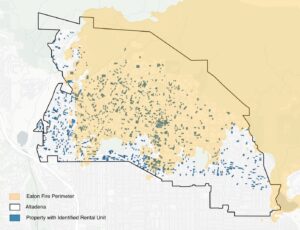
Notes: Recorded rental units refers to rental listings that we identified to a specific property in Altadena prior to the Eaton Fire.
Source: UCLA LPPI analysis of Renthub, Dwellsy and DCBA Rent Registry Rental Unit Listings; Los Angeles County Office of the Assessor, “Assessor Historical Parcel Data File”; and California Department of Forestry and Fire Protection, CAL FIRE Damage Inspection Program (DINS) database, accessed September 16, 2025, available online.
However, fire damage was often severe. Among properties with recorded rental units, 43 percent had buildings that were more than 50 percent destroyed.45 It is important to note that our analysis of damage assessments captures severe damage to any residential structure on a parcel and does not specify whether the rental unit itself was the structure destroyed. Even if the unit itself was not affected, the destruction of a residence would have disrupted living conditions for tenants on those properties due to the loss of utilities, access, or habitable space.
Beyond cases of severe destruction, the remaining properties within the fire perimeter—including roughly one quarter of all properties with recorded rental units—experienced varying levels of fire-related impacts, such as minor structural damage or smoke damage and post-fire contamination. This equates to 352 properties with 589 recorded rental units experiencing some impact from the fire.46 These impacts have already emerged as significant barriers to re-occupancy and recovery in Altadena.47
7. A substantial share of Altadena’s rental housing was rent-stabilized and located in fire-affected areas. Prior to the Eaton Fire, there were about 792 recorded rent-stabilized units in Altadena. Over two thirds of these units were located within the fire perimeter.
Rent stabilization played a meaningful role in Altadena’s rental market prior to the Eaton Fire. Because rent-stabilized units are difficult to fully observe in administrative and market data (see methodology), we distinguish between two categories of units. First, we identify Altadena properties with recorded rental units that were registered with the Los Angeles County Department of Consumer and Business Affairs (DCBA) as rent-stabilized. We refer to these as recorded rent-stabilized properties and their associated units as recorded rent-stabilized units. Second, we identify Altadena properties that based on their unit size and age48 would have been subject to rent stabilization if they had recorded rental units prior to the fire, but for which we did not observe recorded rental listings in our dataset. We refer to these as potentially rent-stabilized properties and their associated units as potentially rent-stabilized units.
It is important to account for these potentially rent-stabilized properties and units because DCBA has acknowledged compliance challenges in unit registration. As a result, some rent-stabilized units may not appear in administrative records even if they were legally covered. Including both recorded and potentially rent-stabilized properties allows us to better estimate the full scope of tenant protections that existed prior to the fire and therefore what may have been lost.
Looking first at recorded rent-stabilized, we identified 230 properties (17 percent of all recorded rental properties) containing 792 recorded rent-stabilized units, or 37 percent of all recorded rental units (Figure 9). This substantial share underscores the central role rent stabilization played in Altadena’s pre-fire rental market.
However, focusing only on recorded rent-stabilized properties likely understates the total scope of rent stabilization. We estimate that an additional 244 properties, which would add up to a total of 474 properties, were potentially rent-stabilized (Figure 9). These properties could have included approximately 1,324 potentially rent-stabilized units.
Figure 9. Number of Recorded Rent-Stabilized Properties and Units and Potentially Rent-Stabilized Properties and Units Compared to All Rental Properties and Units in Altadena, Prior to the January 2025 Eaton Fire
Note: “Rent-stabilized” refers exclusively to fully regulated units under the County’s Rent Stabilization and Tenant Protections Ordinance. Recorded rental units refers to rental listings that we identified to a specific property in Altadena prior to the Eaton Fire. Potentially Covered by Rent Stabilization refers to properties—and the total number of units within those properties—that Los Angeles County’s Department of Consumer and Business Affairs (DCBA) has assessed as likely subject to rent stabilization if rental units existed on the parcel prior to the Eaton Fire. This designation reflects a theoretical eligibility determination based on County policy criteria. Final rent stabilization status is subject to DCBA review and confirmation through property registration and compliance processes. “Rent-stabilized” refers exclusively to fully regulated units under the County’s Rent Stabilization and Tenant Protections Ordinance.
Source: UCLA LPPI analysis of DCBA Online Rent Registry lookup tool, Renthub, Dwellsy and DCBA Rent Registry dataset
Analysis of fire damage assessments show that rent-stabilized housing was also widely exposed to the Eaton Fire. More than two thirds (66 percent) of properties with at least one recorded rent-stabilized unit were located within the fire perimeter, indicating that a substantial share of tenants living in regulated housing experienced evacuation, displacement, or disruption in the immediate aftermath of the fire.49 This equates to 151 properties with 545 recorded rent-stabilized units.
Among properties with recorded rent-stabilized units, 39 percent had buildings that were more than 50 percent destroyed by the fire. As with the broader rental stock, these damage assessments reflect severe impacts to any residential structure on a parcel and do not necessarily indicate that the rent-stabilized unit itself was destroyed. Even so, the loss of a residential structure on the property would have disrupted living conditions for tenants. Beyond cases of complete destruction, about one third of rent-stabilized properties within the fire perimeter experienced lesser, but still consequential, impacts, including moderate, minor damage, smoke damage, and post-fire contamination.50
8. Rent stabilization in Altadena had strong affordability benefits for family-sized units before the Eaton Fire, creating substantial rent gaps relative to the non-rent-stabilized market. On average, rent-stabilized two-bedroom units rented for approximately $600 less per month than comparable non-rent-stabilized market units, while rent-stabilized three-bedroom units rented for about $700 less.
Recorded rent-stabilized units in Altadena differed meaningfully from non-rent-stabilized units. Rent-stabilized units were more likely to be located on small, multifamily properties: nearly two thirds were situated on multifamily properties, whereas roughly 74 percent of recorded non-rent-stabilized units were located in single-family residences. Recorded rent-stabilized units were also slightly older on average. The median build year of the main building on their property was 1941 for rent-stabilized units compared to 1946 for recorded non-rent-stabilized-market units, underscoring that many rent-stabilized units were part of Altadena’s older, legacy rental stock.
The impact of rent stabilization differed by unit size (Figure 10). Overall, rents increased as unit size increased, and recorded rent-stabilized units were generally priced below comparable recorded non-rent-stabilized units. This pattern was most consistent for larger units, where housing types tend to be more uniform.
Among the smallest unit types, the rental price pattern between recorded rent-stabilized and non-rent-stabilized units was relatively similar. Estimated average rents for recorded rent-stabilized studios were on par with those observed in non-rent-stabilized units (Figure 10). Recorded rent-stabilized and non-rent-stabilized studios both had estimated average rents of about $1,500. Importantly, the non-rent-stabilized market also offered smaller unit mixes of single rooms in shared apartments that offered lower rates than studios, at an average rent of $1,000.
Rent stabilization played a large role in preserving the affordability of larger, family-sized rental housing in Altadena prior to the fire. Recorded two-bedroom rent-stabilized units had estimated average rents of $2,200, compared to $2,800 in the non-rent-stabilized market. For three-bedroom units, we estimate that rent-stabilized rents averaged $3,100, about $700 less than non-rent-stabilized units (which averaged $3,800). The largest gaps appear among four-bedroom and larger units, where recorded rent-stabilized estimated rents averaged $3,200 and non-rent-stabilized listings about $5,300.
This affordability gap is especially significant because larger units are already a small share of the rental stock. In the City of Los Angeles, for example, only about 14 percent of rental units have three bedrooms or more.51 The relative scarcity of family-sized rentals means that the loss or price escalation of larger units in Altadena places disproportionate pressure on renting families, particularly those with children or multigenerational households.
Additionally, these pricing patterns matter because Altadena was already a high-cost rental market prior to the Eaton Fire. Using the U.S. Department of Housing and Urban Development (HUD) Fair Market Rents as a benchmark, the greater Altadena52 area ranked at the 77th percentile for one-bedroom rents countywide, meaning rents in the greater Altadena area were higher than in most ZIP codes in Los Angeles County.53 In this context, rent stabilization helped limit rent pressures for many tenants, particularly families needing larger units. Without these protections, post-fire market disruptions are likely to place even greater strain on affordability for tenant households.
Figure 10. Estimated Average Monthly Rental Price of Rent-Stabilized and Non-Rent-Stabilized Market Units in Altadena Before the January 2025 Eaton Fire
Note: Studios refer to apartment units described as open loft, studios, or 0-bedroom rentals. Single rooms refer to single room rentals in a larger unit. Unknown units are those where no bedroom count was provided or could not be identified with the available listing data. All rental prices were rounded to the nearest $100. There were 159 units for which we could not identify unit bedroom size; they were removed from this analysis but included in the “All” average rental estimates. Average rents for larger rent-stabilized units (particularly 3- and 4+ bedroom units) should be interpreted with caution due to small sample sizes relative to the non-rent-stabilized market, which may contribute to greater variation in estimated rents.
Source: UCLA LPPI analysis of Renthub, Dwelley and DCBA Rent Registry Rental Unit Listings.
9. The Eaton Fire may have reduced the supply of naturally occurring affordable housing. Non-rent stabilized units located on properties that sustained severe damage (defined as 50 percent or more of the building destroyed) had rents that were, on average, 17 percent lower than comparable non-rent-stabilized units on properties that did not sustain severe damage.
Across nearly every bedroom size, non-rent-stabilized units located on properties that sustained severe damage (50 percent or more of the building destroyed) rented for less than comparable units on properties that did not sustain severe damage. On average, recorded non-rent-stabilized units on severely damaged properties had rents that were about 17 percent lower than recorded non-rent-stabilized units on properties without severe damage (see Figure 11).
This rental pattern suggests that the Eaton Fire may have disproportionately eliminated some of Altadena’s naturally affordable, non-rent-stabilized rental housing units; these are units that were cheaper not because of formal protections, but because they were older and had more limited amenities. The potentially destroyed non-rent-stabilized units had a main building with a median build year of 1946, and roughly 80 percent were single-family properties, similar in structure to much of Altadena’s rental stock. Notably, 40 percent of non-rent-stabilized units located on properties that sustained severe damage (259 units) were three- and four-bedroom homes, indicating the loss of family-sized rentals that had offered relatively lower-cost options in the market prior to the fire. Together, these characteristics indicate that the fire reduced a segment of the rental supply that had quietly provided affordability—particularly for larger households—without the benefit of rent stabilization.
While rent-stabilized units were also affected, the price differences between all rentals and rent-stabilized units on non-rent-stabilized units located on properties that did or did not sustain severe damage are smaller and less consistent, reflecting the role of rent regulation in limiting price variation among units. In contrast, losses in the non-rent-stabilized market are likely to place added pressure on affordability during recovery, especially for families seeking larger units in an already expensive rental market (see Appendix Tables C and D).
Figure 11. Average Monthly Rent of Non-Rent-Stabilized Units on Severely Damaged Properties (≥50% Destroyed) Compared to Units on Properties Without Severe Damage, Altadena (Pre-January 2025 Eaton Fire)
Note: Studios refer to apartment units described as open loft, studios, or 0 bedroom rentals. Single rooms refer to single room rentals in a larger unit. Unknown units are those where no bedroom count was provided or could not be identified with the available listing data. All rental prices were rounded to the nearest $100. Average rents reflect observed rental listing prices prior to the Eaton Fire. “Destroyed Units” include rental units located on parcels classified as destroyed (>50%). Differences are descriptive comparisons intended to illustrate how rental units lost to the fire compared to the broader Altadena rental market. Sample sizes vary by bedroom category, but a total of 627 non-rent-stabilized units were potentially destroyed by the fire.
Source: UCLA LPPI Analysis of Renthub, Dwellsy, DCBA Rent Registry Listing and California Department of Forestry and Fire Protection, “CAL FIRE Damage Inspection Program (DINS) Database,” accessed September 16, 2025, available online.
10. Rental housing recovery has been slow in the aftermath of the Eaton Fire, with limited sales, listings, or rebuilding activity one year later. One year after the fire, about 74 percent of all rental units within the fire perimeter were on properties with not publicly observable recovery action.
A majority of the 1,525 recorded rental units that were located within the Eaton Fire perimeter have not experienced any observable recovery-related action one year after the fire. These are the units that have likely already been removed from the rental market due to fire/smoke damage or hazard contamination. Focusing on the recovery activities in these units tells us about the prospects of recovery for the units and potential return of tenants.
Few recorded rental units were on properties that were sold or listed for sale in the first year of recovery. About six percent of recorded rental units were located on properties that had been sold as of January 31, 2026 and an additional two percent were on properties listed for sale (Figure 12). Notably, the limited sales and listings observed during the first year of recovery were disproportionately concentrated among rent-stabilized properties.
All recorded rental units were more likely to be on properties that are being rebuilt and repaired after the fire. Nearly one in five (18 percent, or 278 units) recorded rental units in the fire perimeter were on properties that have filed a wildfire recovery or general reconstruction permit in the year since the fire. Recorded rent-stabilized units were more likely to be associated with a property with permitting activity than those that were non-rent-stabilized: 22 percent of recorded rent-stabilized units (122 units) had property-level permits in the pipeline compared to 16 percent of non-rent-stabilized rent units (153 units). This pattern may be related to differences in property scale and rebuilding considerations of rental properties. Rent-stabilized units are more often located on multi-unit properties (such as duplexes, triplexes, and apartment buildings) where damage can affect multiple units and rebuilding may restore several rentals at once. By contrast, recorded non-rent-stabilized rental units are more frequently located on single-family properties, where owners may face different financial risks or considerations when deciding whether to pursue reconstruction after the fire.
It’s important to note that rebuilding does not guarantee that previously rent-stabilized units will retain their full protections. Under the RSTPO, full coverage is tied to the certificate of occupancy: fully covered units are those on properties with a certificate of occupancy issued on or before February 1, 1995.54 If a property experienced partial destruction and retains its original certificate of occupancy, it may continue to be fully covered upon return to the rental market. But if a property was totally destroyed and a new certificate of occupancy is issued upon reconstruction, it may be reclassified and exempt from rent stabilization limits. This regulatory gap means that the rebuilding process itself could remove affordability protections.
Among recorded rental units in the fire perimeter, roughly 74 percent were located on properties that had not been sold, listed for sale, or issued a rebuilding permit. This pattern was similar across both rent-stabilized and non-rent-stabilized units, indicating that slow recovery is widespread in the rental market.
Figure 12. Share of Recorded Rental Units in the Eaton Fire Perimeter in Altadena with Publicly Observable Recovery Actions Taken on the Property, By Rental Property Type, As of January 31, 2026
Note: “Rent-stabilized” refers exclusively to fully regulated units under the County’s Rent Stabilization and Tenant Protections Ordinance. Units with that had taken no action, permitted, on market or sold were exclusive of each other, adding up to 100% of all units.
Sources: UCLA LPPI analysis of Renthub, Dwellsy and DCBA Rent Registry Rental Unit Listings; PropertyShark Property Reports; Redfin, “Altadena, CA Homes for Sale & Real Estate,” available online; and Los Angeles County Planning, EPIC-LA, February 2025-August 2025, available online and California Department of Forestry and Fire Protection, “CAL FIRE Damage Inspection Program (DINS) Database,” accessed September 16, 2025, available online.
Conclusion and Policy Recommendations
Disaster recovery systems in California remain largely oriented toward homeowners, leaving gaps in support for tenants and for the small-scale rental housing that historically supplied much of Altadena’s more affordable housing units. However, the post-fire period also presents a policy opportunity. With coordinated state and county action, recovery investments can be used not only to rebuild structures, but also to stabilize tenants, preserve affordability, and create viable pathways for displaced tenants to return.
Based on our findings, we recommend the following policy actions to support tenant recovery and promote an equitable rental housing rebuild in Altadena and other wildfire-impacted communities:
1. Provide interim and temporary housing stability for displaced residents.
Altadena’s rental recovery will take years, but displacement is ongoing. For many displaced tenants—especially households that previously paid below-market rents—today’s rental market offers few viable or long term options. At the same time, displaced homeowners face increased pressures in the rental market while rebuilding. As their Additional Living Expense (ALE) coverage begins to expire, more homeowners will have to absorb full rental costs out of pocket. As of December 2026, 26 percent of Altadena households reported having no more than 12 months of ALE coverage remaining, and 14 percent reported having run out of coverage.56 As more households lose insurance support, financial strain will intensify and competition for available units will remain elevated, increasing the risk of long-term displacement for both tenants and homeowners. To prevent temporary displacement from becoming permanent, interim housing support is essential.
State policymakers should consider:
- Creating a statewide rapid rehousing program for disaster survivors that funds master leasing at scale (including hotels/motels).
- Providing flexible state block grant funding that counties (or a designated philanthropic intermediary) can deploy quickly for interim housing costs—master lease reserves, operating subsidies, supportive services—without onerous delays that undermine time-sensitive stabilization.
- Funding and standardizing coordinated disaster case management across CBOs and Long-Term Recovery Group partners, including shared intake systems, common eligibility screening and multilingual navigation support to ensure households can access available assistance and progress toward stable housing outcomes.
2. Secure land and capital to rebuild affordable rental housing in Altadena.
While California and Los Angeles County have made significant near-term investments to expand affordable housing options following the Eaton Fire, most existing tools are not designed to prevent the permanent loss of lower-cost rental housing within Altadena itself, the community where displaced tenants lived before the fire. Through the California Department of Housing and Community Development (HCD), the state has committed $164.2 million to support the development of 974 new affordable rental units across Los Angeles County, including $56.9 million for 301 units through the 2025 Multifamily Finance Super Notice of Funding Availability (NOFA) and an additional $107.3 million for 673 units through the 2025 Multifamily Finance Super NOFA – Los Angeles Disaster (MFSN-LA Disaster NOFA).57 Fire-displaced households have also been prioritized for placement on state-assisted affordable housing waiting lists through March 6, 2026.58 These investments are critical for addressing regional housing needs, but they largely operate through longer-term, competitive development pipelines and do not directly intervene in the rapid, post-disaster market dynamics unfolding in Altadena.
Property sales often accelerate after wildfires as owners face rebuilding costs, insurance shortfalls, or prolonged displacement. Without coordinated intervention, these transactions can favor speculative or cash buyers, permanently removing lower-cost rental properties from the market and narrowing the range of housing options available to returning tenants.
To counteract these pressures, state and county governments should focus on building the infrastructure needed for public and nonprofit entities with affordability goals to acquire, hold, invest, and redevelop fire-impacted properties. If public agencies are facilitating and approving rebuilding in Altadena, recovery policy should ensure that affordability is treated as a core outcome of that rebuilding process.
State policymakers should consider:
- Creating a locally administered registry of market-listed, fire-impacted properties that provides qualified nonprofit and public entities with a right of first refusal. Through this registry, eligible entities would register in advance and commit to developing affordable rental housing, affordable homeownership opportunities, or community land trust models. Comparable legislative proposals, such as California SB 658 introduced in 2025,59 illustrate how the state could authorize and fund this type of acquisition infrastructure.
- Funding a recovery-specific landbanking initiative through a state block grant. As our research shows, nearly three-quarters (74 percent) of severely damaged properties have taken no public recovery action to date, meaning thousands of parcels remain in limbo. Without timely intervention, prolonged insurance gaps and rebuilding delays may push financially strained owners to sell to cash investors, accelerating speculative acquisition and permanently reshaping the local rental market. The State should establish a dedicated disaster-recovery block grant to capitalize landbanking efforts in Altadena and other fire-impacted communities. A flexible block grant funding—potentially administered through California Department of Housing and Community Development (HCD) or a designated philanthropic intermediary—should be dispersed to qualified nonprofit developers, community land trusts, and public entities to support the acquisition of fire-impacted properties for affordable rental housing, affordable homeownership, and community-serving redevelopment. By securing land early in the recovery process and stabilizing acquisition costs, this strategy would help preserve long-term affordability.
- Targeting or creating recovery-specific HCD acquisition and development programs to support affordable and middle-housing development in Altadena’s historically higher-density and commercial corridors. These programs could provide the upfront capital needed for nonprofit, public, and mission-driven private developers to acquire land and pursue affordability-oriented redevelopment during recovery while ensuring that new housing is built to modern resilience standards and located away from higher-risk hillside areas.
3. Streamline approvals for “missing middle housing” and long-term affordable development in Altadena.
Tenant return in Altadena ultimately hinges on affordability; specifically, whether the type, scale, and unit mix of post-fire housing can match what households could reasonably pay before the Eaton Fire. The fire destroyed rental housing across a wide range of rent levels, including many units that were affordable largely because they were older, smaller-scale properties built decades ago. Replacing those units today is fundamentally harder: construction costs are higher, regulatory requirements are more complex, and market pressures are stronger.60 Even when the goal is simply to rebuild what was lost, rebuilding is likely to produce higher rents than before the fire, putting former tenants—especially families seeking larger units—at risk of long-term displacement.
If affordability is the objective, recovery policy must do two things at once: make it less expensive to build rental housing and create clear incentives to rebuild in ways that preserve long-term affordability. Without cost reductions and affordability guardrails, the default outcome of post-fire redevelopment will be higher rents and a permanent shift in the community’s housing profile.
The current policy landscape is not fully aligned with affordability goals. At the state level, temporary executive actions have suspended or limited key provisions of the Housing Crisis Act and the State Density Bonus Law as they apply to post-fire redevelopment, reducing incentives to rebuild housing at higher densities or with affordability commitments.61
At the local level, Los Angeles County’s Rent Stabilization and Tenant Protection Ordinance (RSTPO) generally requires the replacement of regulated affordable units removed from the rental market. However, RSTPO does not distinguish between units voluntarily withdrawn (such as through the Ellis Act) and units effectively removed due to disaster-related destruction.62 As written, there is no automatic requirement that rent-stabilized units destroyed by the Eaton Fire return to the market as rent-stabilized units once rebuilt. This regulatory gap means that climate disasters can unintentionally accelerate the permanent loss of stabilized rental housing.
Altadena’s recovery context presents a rare and time-limited opportunity to act boldly. Unlike most urban areas in Los Angeles County, these fire-impacted neighborhoods are not constrained by a fully built-out environment, and the recovery process has already demonstrated that the County can move quickly and implement innovative policies. For instance, County approved permit fee waivers and refunds for owner-occupied single-family homes63 and created a streamlined permitting pathway for like-for-like rebuilds following the fire.64 Homeowners have been permitted to use temporary housing solutions, such as manufactured homes, RVs, and interim ADUs, while reconstruction is underway. 65 These actions show that, in a disaster context, regulatory flexibility is possible.
The same spirit of innovation should now be extended to rental housing. Recovery provides an opportunity to expand small-scale multifamily forms that were historically common in Altadena: bungalow courts, duplexes, fourplexes, and other “missing middle” typologies that can spread construction costs across multiple units while producing family-sized rentals. But doing so will require aligning incentives, reducing soft costs, and ensuring that rebuilt units contribute to long-term affordability rather than eroding it.
County policymakers should consider:
- Strengthening Rental Continuity Protections During Disaster-Related Unit Withdrawals Under the County’s RSTPO. Los Angeles County should amend the Rent Stabilization and Tenant Protections Ordinance (RSTPO) to explicitly address disaster-related destruction and rebuilding. As currently written, RSTPO contains detailed provisions governing the voluntary withdrawal and demolition of fully or partially covered rental units from the market.66 Under the ordinance, withdrawn and demolished units re-offered for rent within specified timeframes, may be subject to rent stabilization limits, including Section 8.52.050’s “fair and reasonable return” standard, even where newly constructed units replace demolished ones.67 However, the ordinance does not directly address units removed from the market due to natural disasters. This creates a structural gap: fully rent-stabilized units destroyed by the Eaton Fire may permanently exit the rent-stabilized stock once rebuilt. While the CostaHawkins Rental Housing Act limits the County’s authority to impose rent control on newly constructed units,68 the County should clarify within its ordinance how disaster-impacted rental properties are categorized and how continuity and rights-of-return expectations are handled where feasible. Establishing clearer standards would not only address the Eaton Fire but would establish a durable framework for future disasters, helping ensure that emergency events do not have unintended long-term consequences for the stability and affordability of the County’s rental housing stock.
- Expanding the permit fee waiver beyond like-for-like single-family rebuilds. The current permit fee waiver explicitly (worth approximately $30,000 per project)69 explicitly excludes rental housing, creating a significant financial barrier for mission-driven developers.70 Extending this waiver to cover SB9 lot-splitting rental projects and the broader set of gentle density typologies (courtyard clusters, fourplexes, small multifamily) — conditioned on affordability commitments — would create a meaningful financial incentive. These affordability commitments could include affordability covenant or deed restriction that mirrors rent stabilization protections for a defined period (e.g., 20–30 years).
- Establishing a fast-track entitlement process for a defined set of small-scale rental typologies that could be built across select areas of Altadena. This process would mirror the streamlined permitting track already created for like-for-like single-family rebuilds71 for middle housing types including courtyard/bungalow court clusters, duplexes, triplexes, fourplexes, and small multifamily buildings (6-8 units). Projects meeting objective standards could receive ministerial approval without discretionary review or public hearings.
This is the same basic logic many U.S. jurisdictions use when they legalize “missing middle housing” across formerly single-family areas. For instance, Portland’s Residential Infill Project specifically defines cottage clusters as groups of 3-16 detached homes (each under 900 square feet) arranged around a shared courtyard.72 This housing type is particularly well-suited to Altadena because it maintains the detached, single-story character many residents value while creating family-sized rental units at lower price points. Since Portland legalized cottage clusters in 2020, they have become one of the most popular housing typologies, and the average sales price of a middle housing unit was about $250,000 to $300,000 less than that of a comparable new, market-rate, single detached home.73
4. Build countywide rental data infrastructure (rent-stabilized and non-rent-stabilized) to support tenant disaster recovery and long-term housing planning.
The absence of a comprehensive, integrated system for tracking rental housing is a barrier to equitable disaster recovery in Altadena. Prior to the Eaton Fire, no single dataset captured the full rental landscape, including where rental units were located, how affordable they were, or who lived in them. After the fire, these gaps became even more consequential. Fragmented rental data limited the County’s ability to quickly assess how many tenants were displaced, where rental losses were concentrated, how fire damage intersected with existing housing pressures, and what scale and type of rental replacement would be required to support tenant return.
Rental data infrastructure is not only a recovery tool but a core indicator of community health. Without a clear accounting of rental housing, local governments are effectively operating in the dark when responding to housing crises, enforcing tenant protections, or planning for affordability in both disaster and non-disaster contexts. The Eaton Fire underscores the need to treat rental data as essential public infrastructure.
County and City policymakers should consider:
- Initiating a county-city partnership to move toward a more comprehensive, countywide view of the rental market, recognizing that rental housing pressures and displacement do not stop at jurisdictional boundaries. This will involve linking existing administrative systems—including the Los Angeles County,74 City of Los Angeles,75 City of Santa Monica,76 and Culver City77 Rent Registries—which currently capture different aspects of the market but have significant gaps and lack a unified framework.
- Strengthening rent registry enforcement for better data and as a real-time tenant protection mechanism. Under the RSTPO, landlords of fully covered units who are not registered with the DCBA Rent Registry are prohibited from raising rents.78 However, this provision remains under-enforced. As Altadena’s rental market is repaired and rebuilt, the County should prioritize proactive rent registry enforcement — including systematic identification of unregistered rent-stabilized properties and direct tenant notification of this protection — to ensure that tenants returning to rent-stabilized units are not subject to illegal rent increases in the recovery process.
State policymakers should consider:
- Supporting the development of county or regional rental data infrastructure by providing funding to counties, recognizing that local governments often lack the resources to build and maintain integrated systems on their own.
- Advancing a state-supported model for comprehensive rental registries, enabling counties and cities to align data collection, reporting, and enforcement practices across jurisdictions.
Appendix
Detailed Methodology
This report documents the tenant population and rental market that existed in Altadena prior to the January 2025 Eaton Fire to better assess the scale of housing loss, displacement risk, and recovery challenges facing tenants. Because no single public dataset comprehensively captures rental housing in Altadena, this study combines pre-fire demographic data with multiple administrative and rental market datasets to reconstruct the rental landscape at both the unit and property level. These data were then restructured and merged with fire damage and recovery indicators.
Below, we outline the methodology used to (1) describe Altadena’s tenant population prior to the fire and (2) identify and characterize the pre-fire rental market.
Providing Tenant Demographics
To describe the demographic characteristics of Altadena’s tenant population prior to the Eaton Fire, we relied on American Community Survey (ACS) pretabulated tables for the Altadena census-designated place (CDP). Where available, we use 2023 ACS 5-Year estimates, the most recent data at the time of analysis. However, for tenant household race and ethnicity, we rely on 2020 ACS pretabulated tables, as more recent releases did not disaggregate these characteristics for tenant and owner households at the CDP level. All demographic estimates reflect pre-fire conditions and should be interpreted as baseline characteristics of the tenant population prior to displacement.
Identifying Rental Units
There is no single, timely, or public dataset that captures the full universe of rental units in the US, including their locations, characteristics, and rents. To address this limitation, we combined historical RentHub listings, Dwellsy listings, DCBA Rent Registry records, and property-level rent stabilization eligibility data to identify rental units and properties operating in Altadena prior to the Eaton Fire.
This multi-source approach provides a more comprehensive picture of Altadena’s formal rental market. However, it remains an estimate and likely undercounts the full rental landscape. These data may not fully capture informal or non-traditional housing arrangements, including unpermitted units, unregistered accessory units, room rentals, non-lease tenancies, or multigenerational and family-based housing arrangements that often lack an online listing or administrative paper trail.79
I. RentHub Rental Listings
Our first source for market-rate rental activity is RentHub, a rental consulting company that web-scrapes online rental listings from major listing platforms and property management companies.80 We use RentHub data covering January 2014 through December 2025, which includes information on: asking rent, date listed, latitude and longitude, bedrooms and bathrooms counts, square footage, and property amenities (e.g., parking, pool, garage). These data allow us to identify rental units that were actively marketed prior to the Eaton Fire and to analyze rent variation by unit size and location. Importantly, these data help us identify potential rental units; however, not if they were actively occupied by tenants as of the Eaton Fire.
RentHub data have been used by other researchers to study rental markets in Los Angeles County.81 Because the dataset is based on market, online listings, it is biased toward newly available or recently turned-over units. This bias may result in overestimated rental prices, particularly in jurisdictions with rent stabilization policies.82
II. Dwellsy Rental Listings
To further supplement listing-based rental data, we incorporated rental listings from Dwellsy, an online housing search platform for rental housing information and listings. Dwellsy for Altadena covers the period from January 2021 through December 2025. The Dwellsy dataset includes the following variables: asking rent, property management or ownership company name, date listed, latitude and longitude, and listing description. Dwellsy listings are directly submitted by property management companies and housing providers, offering an additional window into the rental market that may not appear on other commercial listing sites. Like other listing-based datasets, Dwellsy data are biased toward available or recently turned-over units, may overstate typical rents in rent-stabilized markets, and do not capture subsidized or income-restricted housing. We use Dwellsy to complement and supplement the market listings provided by RentHub.
III. Rent-Stabilized Units
To better understand the role that rent-stabilization plays in Altadena’s rental market—and to address the known limitations in market listing data above—we incorporate multiple administrative data sources to identify rental housing subject to rent stabilization. This approach allows us to more accurately characterize regulated rents and assess the extent to which rent-stabilized housing may be underrepresented in listing-based datasets.
Rent stabilization in unincorporated areas of Los Angeles County is governed by the Rent Stabilization and Tenant Protections Ordinance (RSTPO), which took effect on December 20, 2018 and applies to eligible rental units in communities such as Altadena.83 Under the RSTPO, covered units are subject to annual limits on rent increases and enhanced tenant protections, including just-cause eviction requirements.
Los Angeles County classifies covered properties into one of two broad categories: 1) fully regulated properties, which are subject to both rent increase limits and eviction protections under the ordinance, and 2) partially regulated properties, which are subject to certain tenant protections (such as eviction protections) but are exempt from rent caps. For the purpose of this analysis, we focus only on fully regulated properties.84 Throughout this report, references to “rent-stabilized” units therefore refer exclusively to fully regulated units under the RSTPO.
To identify the rent-stabilized market, our first step was to identify the full universe of properties in Altadena that could theoretically be subject to rent stabilization, regardless of whether they are currently registered or actively rented. To do this, we leveraged the Los Angeles County Rent Stabilization Program Online Rent Registry, maintained by the Los Angeles County Department of Consumer and Business Affairs (DCBA), which allows landlords and tenants to look up a parcel/property and see DCBA’s determination of whether it is subject to rent stabilization.85 We used an automated querying process to systematically retrieve coverage information for all parcels in Altadena. This step provided a theoretical upper bound on the number of properties and units that could be subject to rent stabilization in the community.
To identify properties that DCBA has formally recorded and registered as operating rent-stabilized units, we obtained administrative records from the DCBA Rent Registry Inventory through a public records request. Registration in the Rent Registry is mandatory for landlords renting covered units under the RSTPO, but compliance relies on self-reporting by landlords and tenants. The Rent Registry includes information such as parcel identification number (APN), date of tenancy for the current tenant, base rent and current rent paid, effective date of current rent, number of bedrooms and bathrooms, and type of regulation under the RSTPO.
Rent Registry data have important limitations and data gaps. Because the registry relies on landlord and tenant self-reporting, it may not capture the full universe of rental housing subject to rent stabilization, particularly when compliance is uneven or when information on new units, tenant turnover, or rent increases has not been consistently updated. In addition, DCBA’s identification of properties and units eligible for rent stabilization relies on recorded unit counts that are central to eligibility determinations but may be incomplete. These data are drawn from Los Angeles County Assessor parcel records, which frequently underreport informal units, unit conversions, or incremental additions such as accessory dwelling units.
We observed evidence of these limitations directly in our data cleaning and analysis. Using DCBA’s parcel-level eligibility tool, we identified approximately 63 properties—representing 79 rental listings—that DCBA classifies as theoretically subject to rent stabilization but that did not appear in the Rent Registry inventory data we obtained; these units were instead identified through market listings (summary statistics available in Appendix Table A). The gap between these sources likely reflects a combination of factors, including 1) undercompliance with the RSTPO especially among small-scale rental arrangements, such as secondary dwelling units, back houses, or room rentals, operated by non-professional landlords who may be unaware that rent stabilization applies and 2) ongoing vacancy, since listing data indicate that a unit was available but not whether it was successfully rented and therefore triggered RSTPO registration requirements.
Rental Pricing
Rental pricing was provided for all three rental listing sources but needed to be filtered and in some cases adjusted to reflect the most contemporary estimate of rent.
Rents observed in the market listings (Dwellsy and RentHub) were analyzed using the most recent observed listing price for each unit in the dataset. Where units appeared multiple times over the past decade, we retained the listing with the most recent date, which we interpret as the marketed rent at the time of the most recent tenant turnover (when units are most likely to experience their largest rent increases). Although this approach allows us to capture turnover-driven price adjustments, it does not observe rent changes that may have occurred during an ongoing tenancy or for units that did not relist during the study period. As a result, we do not attempt to estimate cumulative rent increases over time for non-rent-stabilized units, as doing so would require assumptions about within-tenancy adjustments that cannot be consistently observed across the dataset.
In contrast, rental pricing data obtained from the Los Angeles County Rent Registry for rent-stabilized units at times reflected non-contemporary effective rent dates. Among rent-stabilized units with available pricing information, 174 units reported effective rent dates ranging from 1990 through 2023, indicating that listed rents may not have been updated following initial registration. To estimate potential contemporary rents for these units at the time of the Eaton Fire, we adjusted observed effective rents for units with recorded effective dates between April 1, 2020 and January 1, 2024 using allowable rent increase schedules under Los Angeles County rent stabilization policy.86 For units with effective rent dates on or after April 1, 2020, we treated the base year as 2020, reflecting the start of County rent regulation and the requirement that landlords adhere to permitted annual increases from the date of registration forward, without the ability to apply retroactive rent increases. Allowable increases were then applied sequentially by regulatory period: three percent for rents effective between September 11, 2018 and March 3, 2020; zero percent between March 4, 2020 and March 31, 2023 (due to COVID-19 protections); three percent between January 1, 2023 and December 31, 2023; four percent between January 1, 2024 and December 31, 2024; and 2.6 percent starting January 1, 2025.87 Because the wildfire occurred in early January 2025, only 16 units with effective dates beginning in the first week of January (January 5, 2025 through January 7, 2025) were assumed to have received the allocated 2.6 percent increase for 2025.88 This was based on the assumption that tenants may have been notified of an annual increase prior to the fire.
Identifying Fire Impact and Recovery
Once rental units and properties were identified, we drew on several public data sources to track fire impact and recovery one year after the fire.
To determine which homes were damaged, we relied on CAL FIRE’s Damage Inspection (DINS) program, which records the extent of fire damage on the property.89 The DINS database assigns a damage classification to each structure on a parcel, rather than to the parcel as a whole. However, because the dataset does not consistently distinguish how each structure was used (e.g., primary residence, accessory dwelling unit, utility structure), translating building-level damage into parcel-level impact required methodological decisions.
DINS identifies a “main residence” and structures perceived to be residential, but in practice, accessory dwelling units (ADUs) or backhouses may be classified as utility or non-residential structures. To reduce the risk of misclassification and undercounting damage, we applied the following approach:
- If the main residence or any structure identified as residential was classified as 50 percent or more destroyed, we assigned that damage level to the parcel as a whole.
- For parcels with multiple structures and varying levels of damage, we calculated the average damage level across structures to reflect overall parcel impact and avoid systematically underestimating damage severity.
This approach balances accuracy and caution, recognizing the structural-level nature of the DINS data while aiming to approximate the lived impact of fire damage at the property level.
To track recovery, we used the County’s EPIC-LA permitting system to identify rebuilding activity from February 2025 through January 202690 as well as official sales records from February through January 2026. We identified and validated official sales records using Property Reports from PropertyShark, an online real estate database and property research tool.91 To capture what might still be in the sales pipeline, we identified home sale listings included on Redfin, an online real estate brokerage, as of January 31, 2025.92 Together, these sources provide a comprehensive view of property damage, ownership, sales, and rebuilding efforts in Altadena’s fire zone.
Appendix Tables
Table A. Characteristics of Altadena Properties and Units Subject to Rent Stabilization but Not Registered in the Los Angeles County Rent Registry Inventory
Source: UCLA LPPI analysis of County of Los Angeles Department of Consumer and Business Affairs Rent Registry Inventory and DCBA Online Rent Registry
Table B. Property Types of Altadena Rental Market, Prior to January 2025 Eaton Fire
Notes: *Single-Family Residence includes properties classified as Single-Family Residence and Planned Unit Development (PUD); **Double, Duplex, or Two Units includes properties classified by the assessor with a use code for Double, Duplex, or Two Units, as well as single-family homes identified by the assessor as having a guesthouse; ***Three or Four Units includes properties with a use code for Three or Four Units or Four Units (Any Combination); ****Mixed Use includes properties classified by the assessor under the following use codes: Store (n = 4), Commercial (n = 3), Store and Residential Combination (n = 2), Auto, Recreation Equipment, and Construction Equipment Sales and Service (n = 1), Homes for the Aged and Others (n = 1), Supermarket (12,000 square feet or more) (n = 1), Office and Residential (n = 1), and Private School (n = 1).
Source: UCLA LPPI Analysis of Renthub, Dwellsy, DCBA Rent Registry Listing, and Los Angeles County Parcel Tax Roll Data.
Table C. Average Monthly Rent of All Rental Units on Severely Damaged Properties (≥50% Destroyed) Compared to Units on Properties Without Severe Damage, Altadena (Pre-January 2025 Eaton Fire)
Note: Studios refer to apartment units described as open loft, studios, or 0 bedroom rentals. Single rooms refer to single room rentals in a larger unit. All rental prices were rounded to the nearest $100. Average rents reflect observed rental listing prices prior to the Eaton Fire. “Destroyed Units” include rental units located on parcels classified as destroyed (>50%). Differences are descriptive comparisons intended to illustrate how rental units lost to the fire compared to the broader Altadena rental market. Sample sizes vary by bedroom category, but a total of 936 rental units were potentially destroyed by the fire.
Source: UCLA LPPI Analysis of Renthub, Dwellsy, DCBA Rent Registry Listing, and California Department of Forestry and Fire Protection, “CAL FIRE Damage Inspection Program (DINS) Database.”
Table D. Average Monthly Rent of Rent-Stabilized Units on Severely Damaged Properties (≥50% Destroyed) Compared to Units on Properties Without Severe Damage, Altadena (Pre-January 2025 Eaton Fire)
Note: Studios refer to apartment units described as open loft, studios, or 0 bedroom rentals. Single rooms refer to single room rentals in a larger unit. All rental prices were rounded to the nearest $100. Average rents reflect observed rental listing prices prior to the Eaton Fire. “Destroyed Units” include rental units located on parcels classified as destroyed (>50%). Differences are descriptive comparisons intended to illustrate how rental units lost to the fire compared to the broader Altadena rental market. Sample sizes vary by bedroom category, but a total of 284 rent-stabilized units were potentially destroyed by the fire. Average rents for larger rent-stabilized units (particularly 3- and 4+ bedroom units) should be interpreted with caution due to small sample sizes relative to the non-rent-stabilized market, which may contribute to greater variation in estimated rents.
Source: UCLA LPPI Analysis of Renthub, Dwellsy, DCBA Rent Registry Listing, and California Department of Forestry and Fire Protection, “CAL FIRE Damage Inspection Program (DINS) Database.”
End Notes
1 California Department of Forestry and Fire Protection, “Palisades Fire,” accessed September 11, 2025, available online
2 California Department of Forestry and Fire Protection, “Eaton Fire,” accessed September 11, 2025, available online.
3 Sayma Khajehei and Sara Hamideh, “Post-Disaster Recovery Challenges of Public Housing Residents: Lumberton, North Carolina After Hurricane Matthew,” Urban Affairs Review 60, no. 1 (2023), available online; Marcy C. Comerio, “Housing Issues After Disasters,” Journal of Contingencies and Crisis Management 5, no. 3 (1997): 166-178, available online; “United States Senate Committee on Homeland Security and Governmental Affairs, “Far From Home: Deficiencies in Federal Disaster Housing Assistance after Hurricanes Katrina and Rita and Recommendations for Improvement,” February 2009, available online.
4 Susan L. Cutter, Bryan J. Boruff, and W. Lynn Shirley, “Social Vulnerability to Environmental Hazards,” Social Science Quarterly 84, no. 2, (2003): 242-261, available online; Bob Bolin and Liza C. Kurtz, “Race, Class, Ethnicity, and Disaster Vulnerability,” Handbooks of Sociology and Social Science Research, (Springer Cham, 2017), available online.
5 Betty Hearn Morrow, “Identifying and Mapping Community Vulnerability,” Disasters 23, no. 1 (1999), 1-18, available online.
6 National Apartment Association, “Renters Insurance Premiums Constant,” National Apartment Association, January 23, 2023, available online.
7 Chris Girard and Walter Gillis Peacock, “Ethnicity and Segregation: Post-Hurricane Relocation,” in Hurricane Andrew: Ethnicity, Gender and the Sociology of Disasters, eds. Walter Gillis Peacock, Betty Hearn Morrow, and Hugh Gladwin, (Routledge, 1997), available online.
8 Jee Young Lee and Shannon Van Zandt, “Housing Tenure and Social Vulnerability to Disasters: A Review of the Evidence,” Journal of Planning Literature 34, no. 2 (2018), available online.
9 Nicole Lambrou, Crystal Kolden, Anastasia Loukaitou-Sideris, and Xijing Li, “Housing and Economic Recovery as Interdependent Pathways in the Wake of Wildfires,” International Journal of Disaster Risk Reduction (2025), available online; Nicole Lambrou, Crystal Kolden, and Anastasia Loukaitou-Sideris, “Disaster Recovery Gentrification in Post-Wildfire Landscapes: The Case of Paradise, CA,” International Journal of Disaster Risk Reduction 118, no. 15 (2025), available online.
10 Jee Young Lee and Shannon Van Zandt, “Housing Tenure and Social Vulnerability to Disasters.”
11 The Federal Emergency Management Agency (FEMA) is designed to aid in disaster recovery, working on a case-by-case basis to address individual hardship. When a unit becomes uninhabitable, FEMA will provide financial assistance for up to 14 days after a disaster. After that two-week period, tenants may apply for two-month rental assistance. If needed, applicants may reapply for longer-term assistance, maxing out at 18 months. See for more details, “FEMA Rental Assistance Program,” Los Angeles County Department of Public Works, available online; and Carlos Martín, Carolyn Kousky, Karina French, and Monann Donoghoe, “Vulnerable Families Need a More Responsive and Reliable Federal Disaster Safety Net,” Brookings, November 13, 2023, available online.
12 Nicole Lambrou, Crystal Kolden, and Anastasia Loukaitou-Sideris, “Disaster Recovery Gentrification in Post-Wildfire Landscapes.”
13 Iain Hyde, Lesley Edgemon, Jane Frantz, Autumn Kaiser, Stephany M. Peyton, and Alison Turner, Lahaina Wildfire Study: Impacts of Post-Disaster Housing Programs on Maui’s Economy (Maui County: Argonne National Laboratory 2024), available online.
14 Katie Dickinson, Andrew Rumbach, Elizabeth Albright, and Desarai Crow, Renter’s Experience After Colorado’s Marshall Fire (Boulder: Natural Hazards Center, 2023), available online.
15 On average across areas, the difference between mover and non-mover households’ rents at the bottom decile of the rent distribution was $79 in the year the disaster occurred and $114 the year after. The average difference between mover and non-mover households’ rents at the mean was $64 in the year of a disaster and $84 the year after. Looking at the difference in differences for mover and non-mover households at the bottom decile of the rent distribution, we see that at on average, mover households pay $35 more the year after a disaster, after netting out rent paid by non-mover households in that year and the difference between mover and non-mover households in the year of the disaster. In relative terms, this effect indicates that households renting units at the bottom decile of the rent distribution face a 5 percent premium in the year after a disaster. For mover households at the mean of the rent distribution, the difference in differences is a 2 percent premium. See for more details, Mark Brennan, Tanata Srini, and Justin Steil, “High and Dry: Rental Markets After Flooding Disasters,” Urban Affairs Review 60, no. 6 (2024), available online.
16 Justin Stoler, Mary Angelica Painter, Ethan Sharygin, and Sameer H. Shah, “The Rise of Hazard Gentrification,” International Journal of Disaster Risk Reduction 126 (2025), available online; Nicole Lambrou, Crystal Kolden, Anastasia Loukaitou-Sideris, and Xijing Li, “Housing and Economic Recovery as Interdependent Pathways in the Wake of Wildfire.”
17 For instance, after the Sarpool earthquake in Iran, the share of landlords using real estate agents nearly doubled (from 42 percent pre-earthquake to 82 percent post-earthquake). The share of landlords who rented to relatives decreased from 26 percent to 14 percent. See for more details, Mojgan Taheri Tafti and Richard Tomlinson, “Decisions of Landlords About Their Renters and Rental Units After Disasters,” Natural Hazards Review 22, no. 2 (2021), available online.
18 Eaton Fire Collaborative, Eaton Fire Housing Impact Survey (Los Angeles County, California: Eaton Fire Collaborative, May-July 2025), n=356; sample: affected homeowners and renters of the Eaton Fire; method: online survey, available online.
19 Eaton Fire Collaborative, Eaton Fire Housing Impact Survey.
20 Lucy Briggs, Iris Craige, Alex Ferrer, Lauren Harper, Nils Jepson, Chelsea Kirk, Philip Meyer, and Max Stein, After the LA Fires: Rent-Gouging in the Wake of Disaster (The Rent Brigade, 2025), available online.
21 Fair Market Rent is an estimate by the U.S. Department of Housing and Urban Development of how much it usually costs to rent a modest, good-quality home in a specific area. Fair Market Rent is used as a guideline rather than an exact market price. It sets the highest rent the federal government will use when deciding how much rental assistance to provide through the Housing Choice Voucher Program, since the government assumes that about 40 percent of typical rental homes in an area cost that amount or less. See for more details, U.S Department of Housing and Urban Development Office of Policy Development and Research, “Fair Market Rents,” available online.
22 Lucy Briggs, Iris Craige, Alex Ferrer, Lauren Harper, Nils Jepson, Chelsea Kirk, Philip Meyer, and Max Stein, After the LA Fires: Rent-Gouging in the Wake of Disaster.
23 Department of Angels, Community Voices: LA Fire Recovery Report (Los Angeles County, California: Department of Angeles, October 2025), n=2335; sample; Eaton and Palisades survivors; method: survey, available online.
24 Governor of California, Executive Order N-1-25 (issued Jan. 7 2025), California Office of Executive Services, available online; Governor Gavin Newsom issued a fourth executive order streamlining rebuilding practices, suspending state permitting and environmental review requirements for properties with fire damage. Governor of California, Executive Order N-4-25 (issued Jan. 12 2025), California Office of Executive Services, available online; Gavin Newsom (Calif.), AB 299 (Gabriel): Motels, hotels, and short-term lodging: disasters, Chap. 531, States of 2025 (Cal. 2025-2026), enacted Oct. 10, 2025, available online.
25 Mike Nemeth, “Newsom Extends Rent Cap After L.A Firestorm but Exempts New Rental Housing,” California Apartment Association, March 7, 2025, available online.
26 California Legislature, Disaster Assistance: Tenants, Mobilehome Parks, and Mortgages, Senate Bill 610, introduced 2025, available online.
27 Kathryn Barger and Lindsey P. Horvath, Establishing a Unified Permitting Authority for The Altadena One-Stop Recovery Permitting Center, Los Angeles County Board of Supervisors, April 8, 2025, available online.
28 The fund gives the highest priority to those who have lost both their home and job. For more details see, Kathryn Barger and Lindsey P. Horvath, Motion Establishing the Los Angeles County Fire Recovery Fund, Los Angeles County Board of Supervisors, January 28, 2025, available online.
29 Lucy Briggs, Iris Craige, Alex Ferrer, Lauren Harper, Nils Jepson, Chelsea Kirk, Philip Meyer, and Max Stein, After the LA Fires.
30 Janet M. Gagnon, “Editorial News Alert: Los Angeles County Passes Countywide Eviction Moratorium,” Apartment Association of Greater Los Angeles, February 26, 2025, available online.
31 Janet M. Gagnon, “Editorial News Alert: Los Angeles County Passes Countywide Eviction Moratorium.”
32 Governor of California, Executive Order N-23-25.
33 California Department of Housing and Community Development, On Eve of LA Fire Anniversary, Governor Newsom announces Housing Push to Keep Survivors in Their Communities, January 6, 2025, available online.
34 California Department of Housing and Community Development, On Eve of LA Fire Anniversary, Governor Newsom announces Housing Push to Keep Survivors in Their Communities.
35 Governor of California, Executive Order N-23-25.
36 Jee Young Lee and Shannon Van Zandt, “Housing Tenure and Social Vulnerability to Disasters.”
37 U.S. Census Bureau, “2020 Census: Renters,” last updated October 8, 2021, available online.
38 Vinit Mukhija, Remaking the American Dream: The Informal and Formal Transformation of Single-Family Housing Cities, (The MIT Press, 2002).
39 Justin Stoler, Mary Angelica Painter, Ethan Sharygin, and Sameer H. Shah, “The Rise of Hazard Gentrification”; Nicole Lambrou, Crystal Kolden, Anastasia Loukaitou-Sideris, and Xijing Li, “Housing and Economic Recovery as Interdependent Pathways in the Wake of Wildfire.”
40 U.S. Census Bureau, “B25119 Table: Median Household Income in the Past 12 Months (in 2023 Inflation-Adjusted Dollars) by Tenure” accessed December 4, 2025, available online.
41 Jee Young Lee and Shannon Van Zandt, “Housing Tenure and Social Vulnerability to Disasters.”
42 LPPI analysis of U.S. Census Bureau, 2023 5-Year American Community Survey, “Table B17019: Poverty Status in the Past 12 Months of Families by Household Type by Tenure, Altadena CDP,” accessed December 4, 2025, available online.
43 Jee Young Lee and Shannon Van Zandt, “Housing Tenure and Social Vulnerability to Disasters.”
44 Lucy Briggs, Iris Craige, Alex Ferrer, Lauren Harper, Nils Jepson, Chelsea Kirk, Philip Meyer, and Max Stein, “After the LA Fires.”
45 UCLA LPPI analysis of Renthub, Dwellsy and DCBA Rent Registry Rental Unit Listings; Los Angeles County Office of the Assessor, “Assessor Historical Parcel Data File”; and California Department of Forestry and Fire Protection, CAL FIRE Damage Inspection Program (DINS) database, accessed September 16, 2025, available online
46 Of the properties within the fire perimeter that were not more than 50 percent destroyed, 29 properties experienced major damage (refers to 26–50 percent destroyed), 21 sustained minor damage (refers to 10–25 percent destroyed), 34 were affected (refers to 1–9 percent destroyed), and 266 had no assessed damage due to the fire, and two properties were inaccessible (the assessment team could not physically reach or inspect the property to determine damage).
47 Pasadena Now, “Altadena Homes Face Lingering Indoor Smoke Hazards After Wildfires, Newly-Published UCLA Study Finds.” Pasadena Now, January 2, 2026, accessed on January 28, 2026, available online.
48 Under the RSTPO, Fully covered rent-stabilized units include residential units on properties with two or more units that received a certificate of occupancy on or before February 1, 1995, as well as certain rented mobile homes. For more details see, Los Angeles County, Code of Ordinances §8.52 – Rent Stabilization and Tenant Protections, 8.52.040 General Applicability and Exemptions, available online.
49 UCLA LPPI analysis of Renthub, Dwelley and DCBA Rent Registry Rental Unit Listings; Los Angeles County Office of the Assessor, “Assessor Historical Parcel Data File”; and California Department of Forestry and Fire Protection, CAL FIRE Damage Inspection Program (DINS) database, accessed September 16, 2025, available online.
50 Of the rent-stabilized properties within the fire perimeter, seven experienced major damage (26-50 percent), seven sustained minor damage (10-25 percent), seven were affected (1-9 percent), and 60 had no assessed damage due to the fire. An additional property was inaccessible and is not depicted in the figure due to their small shares.
51 David Wagner, “With No Easy Solutions to Get More Family-Sized Housing Built in LA, Is Public Housing an Option?,” LAist, March 27, 2024, available online.
52 ZIP code of 91001 used as a proxy for Altadena based on HUD Fair Market Rents for ZIP codes.
53 Fair Market Rent comparisons are based on HUD ZIP-code–level estimates for the greater Altadena area and may mask variation across neighborhoods within Altadena.
54 Los Angeles County, Code of Ordinances §8.52 – Rent Stabilization and Tenant Protections, 8.52.040 General Applicability and Exemptions.
55 Gabriella Carmona, Paul M. Ong, Xalma M. Palomino, Vinit Mukhija, and Rodrigo Dominguez-Villegas, Who’s Coming Home? An Analysis of the Property Sales, Permits, and Rebuilding Efforts of Single-Family Homeowners in Altadena, CA After the Eaton Fire (Los Angeles: UCLA Latino Policy & Politics Institute, October 8, 2025), available online.
56 Department of Angels, “One Year In: What Our Communities Have Taught Us About Recovery,” February 6, 2026, available online.
57 California Department of Housing and Community Development, “On Eve of LA Fire Anniversary, Governor Newsom announces Housing Push to Keep Survivors in Their Communities,” (press release, January 6, 2025), available online.
58 Governor of California, Executive Order N-23-25.
59 CalMatters Digital Democracy, “AB 851: Real Property Transactions: Counties of Los Angeles and Ventura Wildfires: Unsolicited Offers,”accessed February 17, 2026, available online.
60 JDJ Consulting Group, “Construction Costs Los Angeles Surge 5.9%, Adding Pressure to Fire Rebuilding,” JDJ Consulting, available online; Bwengr.com,“Rebuilding Altadena”, Bwengr, available online; Perla Shaheen, “Rebuilding after Disaster: L.A. Fire Victim Faces Rising Construction Costs,” 10News, June 6, 2025, available online.
61 Governor of California, Executive Order N-23-25.
62 Los Angeles County, Code of Ordinances §8.52 – Rent Stabilization and Tenant Protections, 8.52.040 General Applicability and Exemptions.
63 LA County Recovers, “Fee Waivers and Refunds,” accessed September 24, 2025, available online.
64 LA County Recovers, “Step 3: Start Your Permit Application,” accessed September 24, 2024, available online.
65 LA County Recovers, “Step 3: Start Your Permit Application.”
66 Los Angeles County, Code of Ordinances §8.52 – Rent Stabilization and Tenant Protections, 8.52.040 General Applicability and Exemptions.
67 Los Angeles County, Code of Ordinances §8.52 – Rent Stabilization and Tenant Protections, 8.52.040 General Applicability and Exemptions.
68 California Civil Code § 1954.50 (Costa-Hawkins Rental Housing Act)
69 County of Los Angeles, “Los Angeles County Previews New Blueprint to Speed Rebuilding and Cut Costs for Residents as Next Phase of Restoration Begins,” (press release, July 7, 2025), available online.
70 County of Los Angeles, “Fee Waivers & Refunds,” accessed on February 17, 2026, available online.
71 LA County Recovers, “Step 3: Start Your Permit Application.”
72 City of Portland, “Residential Infill and Middle Housing Land Divisions in Single-Dwelling Zones,” accessed on February 17, 2026, available online.
73 City of Portland Bureau of Planning and Sustainability, “Portland Sees Significant Production in Middle Housing Resulting from Recently Adopted Zoning Changes, Report Finds,” (press release, February 4, 2025), available online.
74 Los Angeles County Department of Consumer and Business Affairs, “Los Angeles County Rent Stabilization Program Online Rent Registry,” accessed January 29, 2026, available online.
75 Los Angeles Housing Department, “Rent Registry,” available online.
76 City of Santa Monica, “How to Register a New Tenancy,” accessed on February 17, 2026, available online.
77 City of Culver City, “Rental Unit Registration,” accessed on February 17, 2026, available online.
78 Los Angeles County Department of Consumer and Business Affairs, “Rent Stabilization Bulletin: Annual Allowable Rent Increase,” accessed February 1, 2026, available online.
79 Vinit Mukhija, Remaking the American Dream: The Informal and Formal Transformation of Single-Family Housing Cities. (Cambridge, MA: The MIT Press, 2002).
80 RentHub collects rental listing data on a biweekly basis beginning in 2014; however, coverage is less complete for the 2017 and 2018 calendar years.
81 Jorge De la Roca, Marco Giacoletti, and Lizhong Liu, “Mortgage Rates and Rents: Evidence from Local Mortgage Lock-In Effects” (working paper, University of Southern California; University of Notre Dame Mendoza College of Business; RAND Corporation, March 28, 2025), available online.
82 RentHub data also exclude subsidized and income-restricted rental housing. For a more detailed discussion of data limitations, see Jorge De la Roca et al,“Mortgage Rates and Rents: Evidence from Local Mortgage Lock-In Effects,” 8–9.
83 Los Angeles County Department of Consumer and Business Affairs, “Information About Los Angeles County’s Temporary Rent Stabilization Ordinance for Property Owners,” accessed January 29, 2026, available online.
84 Under the RSTPO, fully covered units generally include residential units on properties with two or more units that received a certificate of occupancy on or before February 1, 1995, as well as certain rented mobile homes, or partially covered units include most rental units in unincorporated areas—such as single-family homes and condominiums—unless specifically fully exempt. Exemptions are provided to properties that are either: 1) institution facilities, 2) government or owned housing, 3) hotel, motel, or other transient guest facility, 4) owner-occupied shared housing, and/or 5) unit is vacant or for nonrental purposes. For more details see, Los Angeles County, Code of Ordinances §8.52 – Rent Stabilization and Tenant Protections, 8.52.040 General Applicability and Exemptions, available online.
85 Los Angeles County Department of Consumer and Business Affairs, “Los Angeles County Rent Stabilization Program Online Rent Registry,” accessed January 29, 2026, available online.
86 Los Angeles County Department of Consumer and Business Affairs, “Rent Stabilization Bulletin: Annual Allowable Rent Increase,” accessed February 1, 2026, available online.
87 Los Angeles County Department of Consumer and Business Affairs, “Rent Stabilization Bulletin: Annual Allowable Rent Increase.
88 Beginning in 2025, Los Angeles County implemented staggered allowable rent increase caps under the Rent Stabilization and Tenant Protections Ordinance, with limits of 2.566 percent for most rent-stabilized units, 3.565 percent for small landlords, and 4.565 percent for certain higher-rent units. Because unit-level information needed to determine eligibility for higher caps was not consistently available, we applied a uniform 2.6 percent increase across all rent-stabilized units to avoid overstating potential rent levels. Los Angeles County Department of Consumer and Business Affairs, “Rent Stabilization Bulletin: Annual Allowable Rent Increase.
89 California Department of Forestry and Fire Protection, “CAL FIRE Damage Inspection Program (DINS) Database,” accessed September 16, 2025, available online.
90 Los Angeles County Planning, EPIC-LA, “Public Information,” accessed February 2025-August 2025, available online.
91 PropertyShark, Property Reports, accessed August 2025; Los Angeles County Office of the Assessor, “Assessor Historical Parcel Data File,” and Redfin, “Altadena, CA Homes for Sale & Real Estate,” available online.
92 Homes were counted as “on the market” if they were listed for sale on Redfin, “Altadena, CA Homes for Sale & Real Estate,” as of September 15, 2025.